
Claims data management for health plans
$300 million in claims nobody could reconcile.
A health plan serving millions of members had claims data spread across more than 20 systems, and hundreds of millions of dollars in claims it could not reconcile. With Gaine HDMP it reconciled $300 million of them and cleared the backlog.
Claims data management, for a health plan, means every claim resolves to the right member, provider, location and contract in every system that touches it. This is how Gaine does it.
How a backlog builds
- Claims cannot be matched. The member, provider or contract a claim points to differs between systems, so the claim reconciles in none of them.
- Payment slows. Unreconciled claims wait for someone to research them by hand.
- Providers resubmit. Waiting on payment, they send the same claims again, and each resubmission adds another claim to research.
- The backlog compounds. Manual reconciliation falls further behind, and provider relationships suffer.
In the case study this ran to hundreds of millions of dollars across more than 20 systems.
How Gaine works
- Resolve the records first. Members, providers, locations and contracts are mastered across every system, with effective dates, so a claim has one right answer to point to.
- Link every claim. Each claim is tied to its member, its rendering and billing provider, its service location and its contract.
- Collapse the duplicates. Resubmissions are recognized as the same claim, so it is worked once.
- Send each system the difference. Core administration, finance and payment integrity each receive only the change they need, with the evidence, by their own route. The warehouse receives the reconciled records one way.
Watch the case
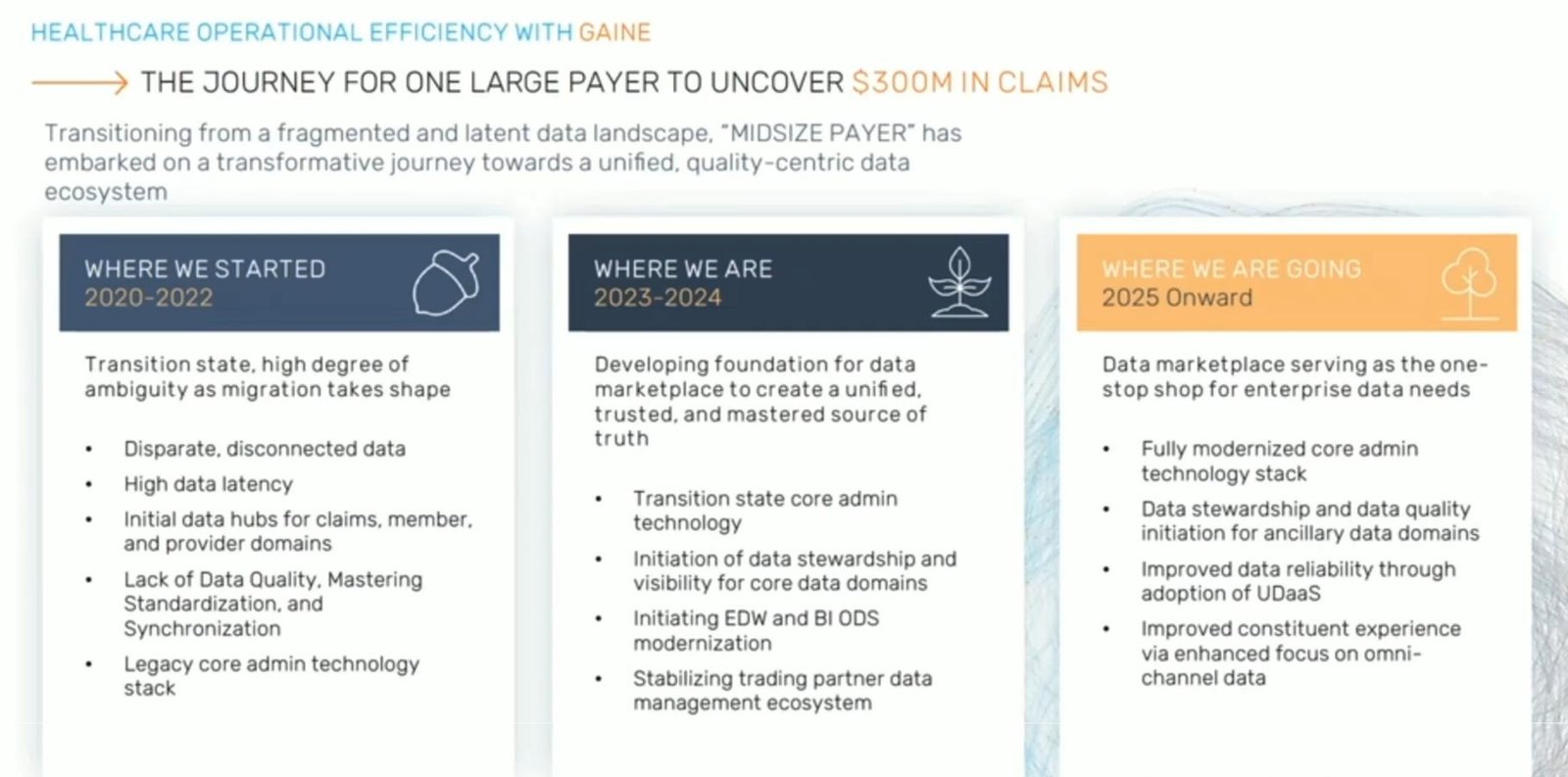
Gaine’s James Godwin and Raj Shah present the case at VIVE. The slide below is from the session.
How claims and changes move
Claims in
- Core administrationread from your claims system
- Your data lakeloaded by your own processes, read by Gaine through a data share
- Filesextracts and flat files
Gaine HDMP
Links each claim to its member, provider, location and contract, and recognizes duplicates
Changes out
- HealthRules Payer
- Facets
- QNXT
- EZ-CAP
Questions
Why do resubmissions make a backlog worse?
Each resubmission is another claim to research unless it is recognized as the same claim. Gaine recognizes it, so the claim is worked once.
Which systems were involved in the case?
More than 20. The case study does not name them.
Related reading
More on claims data management
The records behind every claim
A claim is only as clean as the member, provider, location and contract it points to. Gaine resolves those records first, so every system gives the claim the same answer.
Explore furtherBeside your clearinghouse
Your clearinghouse moves claims and core administration pays them. Gaine keeps the records they depend on in agreement, and takes no part in transmission.
Explore further