Gaine Operational Control.
Gaine HDMP is an operational health data management platform. It resolves every healthcare entity — patients, providers, organizations, networks, contracts, products — against a healthcare ontology refined over more than fifteen years, then keeps the systems that run your operations aligned with the result.
Request a demoSee how it works
Each system receives only what changed, with the evidence for why.
Who we serve
Health plans
Modernization typically means running old systems and their modern replacements side by side for years. Gaine resolves every entity across both — and keeps every system acting on the result.
Explore →Provider organizations
Patient identity and provider data management are sold separately. The gap between them is where referrals leak, quality suffers, and claims are rejected. Gaine resolves both — and the relationship between them.
Explore →Life sciences
You are organized by brand. Your patients and HCPs are not — so what you know about them is split across brands and lost over time. Gaine resolves identity, history and consent into one record no brand could assemble alone.
Explore →Public health agencies
Coordinating care and reporting to a funder is only possible when the people, the organizations serving them and the services delivered are correctly identified. Gaine resolves all three across the systems they already run.
Explore →
Gaine by the numbers
- 2.7B+Records mastered
- 500M+Transactions processed annually, in real time
- 50M+Patient consents under management
- 3,500+Data elements in the ontology
- 15+Years refining the healthcare ontology
- 36%Average improvement in provider network accuracy
- 4.7Stars out of 5 in Gartner Peer Insights reviews
Figures as of September 2026.
The platform
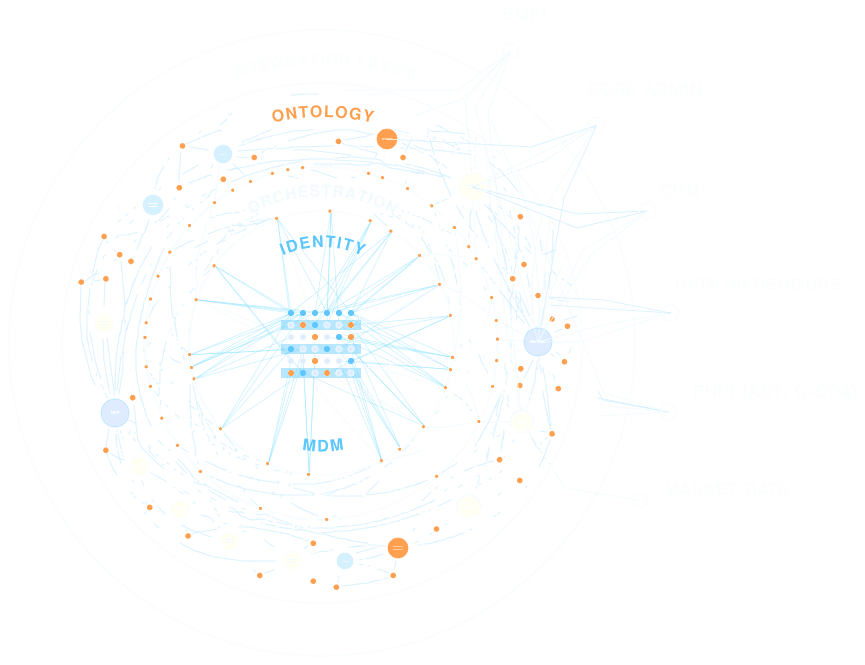
Four layers, and what each one does to your data.
- 01
Integration layer
Gets data in, and gets change back out.
Data exchange between connected systems and the HDMP. Integration options are API, file exchange, replication and event notifications.
- 02
Ontology
The model your data is resolved against.
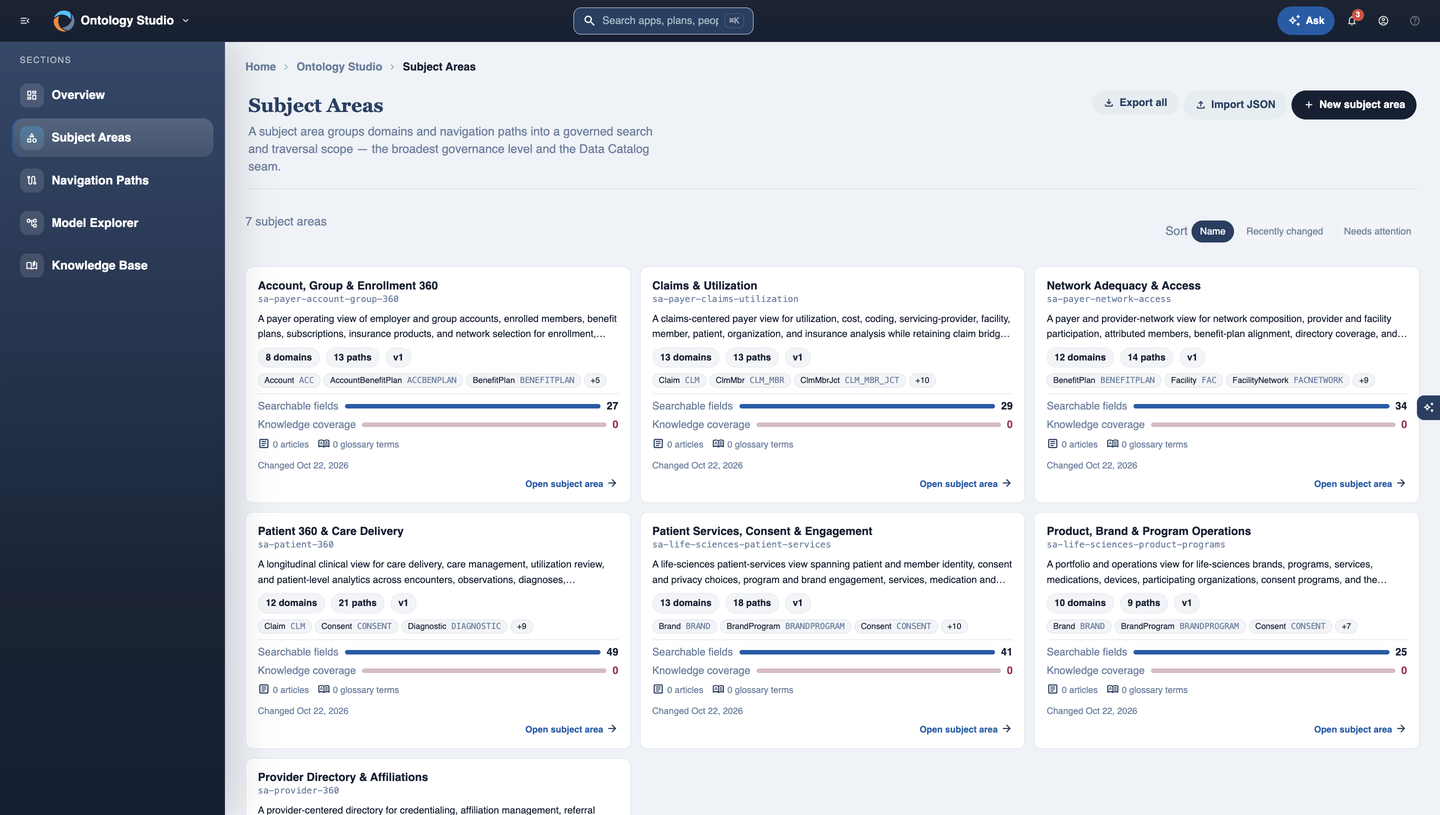
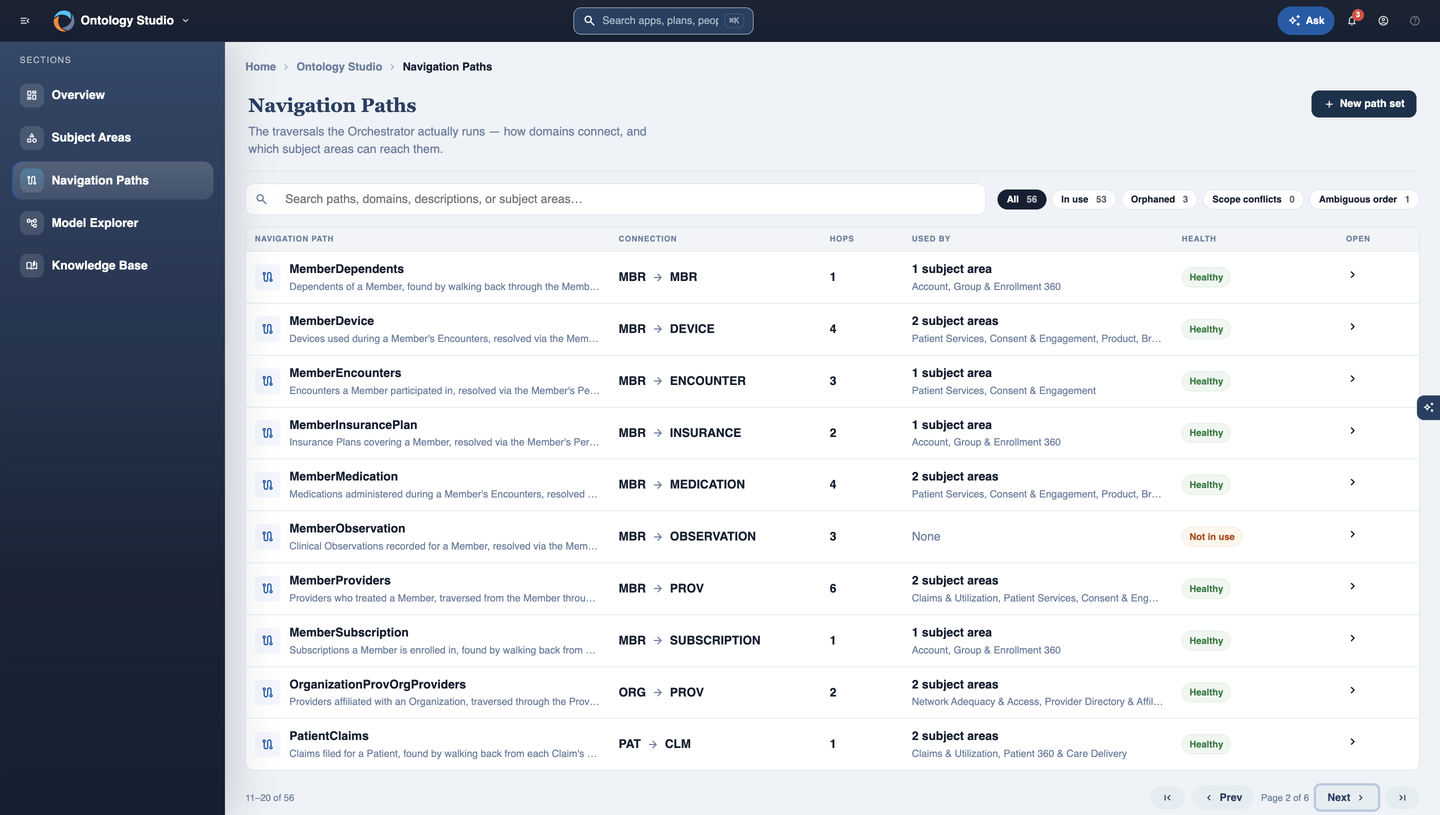
A broad industry ontology of 3,500+ data elements, refined over 15+ years. Yours to adopt or extend.
- 03
Orchestration
Aligns each transaction with the record it belongs to.
Aligns transactions with the mastered data that gives them context and structure. 500M+ transactions processed annually, in real time.
- 04
Identity and MDM
Decides what is true, and shows why.
Matching, merging, cleansing and survivorship across domains, with a cross-reference to every contributing system.
Maximize leverage. Gaine does not require you to re-master data you have already mastered. Where an EMPI, a patient master or a provider master is in place, Gaine absorbs its identifiers and masters the data around it. If a match is wrong, unmerge is a first-class operation: restoring masters and cross-references, and notifying impacted systems of the change.
Data Explorer and Ontology Studio
The difference
Operational and analytic data platforms have different roles.
Health plans
A corrected provider profile that doesn’t get back into the core admin system does nothing to improve auto-adjudication rates.
Provider organizations
A network change that never reaches the referral system still sends the patient out of network.
Life sciences
A consent withdrawal through one of your brand sites that doesn’t reach your other brands creates an exposure.
Public health
Identifying high-needs patients is meaningless unless they reach the case management system.
Health plans, provider organizations, manufacturers and public health agencies have all spent a decade buying platforms that analyze data. An analytical platform is built to be read from: it gathers, models and reports. An operational platform has to write back — to put a governed record into the system where the work happens, on that system’s terms, with the evidence for the change. Very few organizations have anything that does the second job.
01 — Every entity
Healthcare is more than patients and providers.
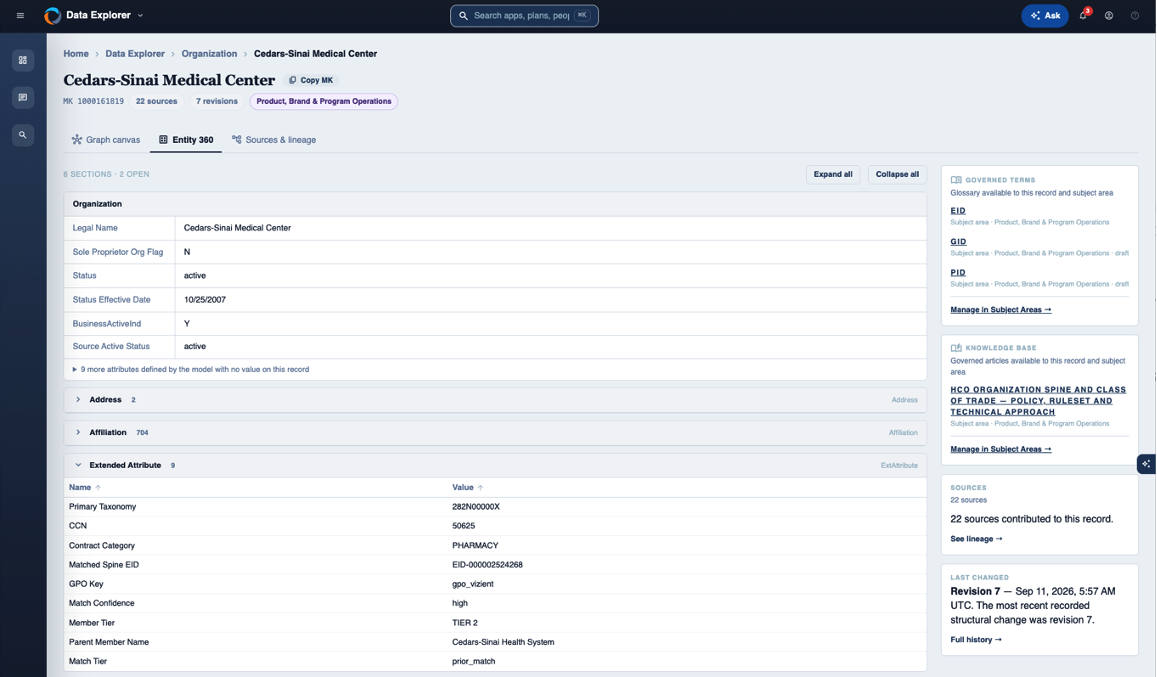
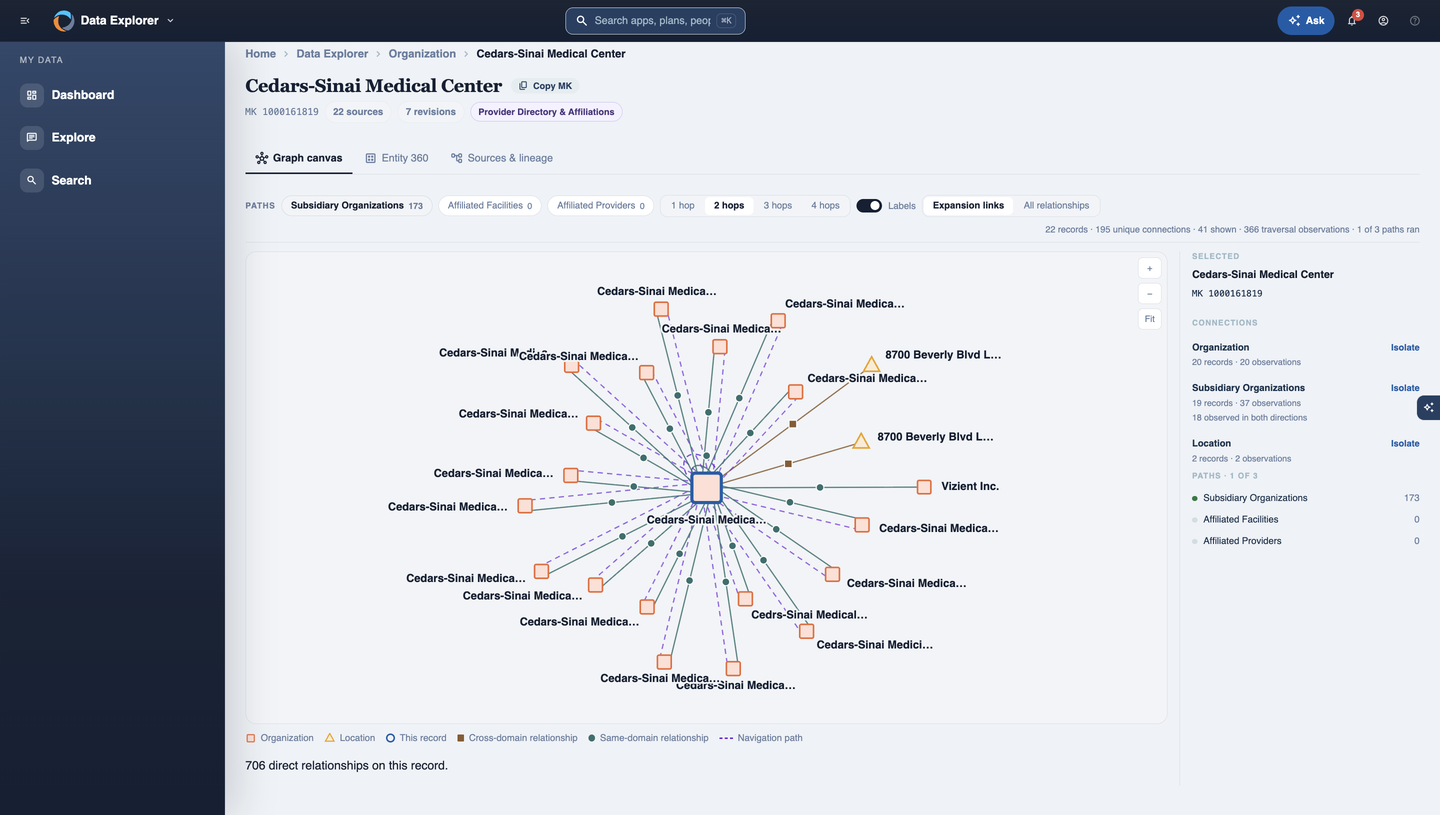
Gaine resolves organizations, networks, contracts, products, locations and affiliations as first-class entities — not just patients and providers. The messy middle is where payer operations actually break: which entity is contracted, under which network, at which location, for which product, effective when.
“We’ve expanded beyond patient data with granular attributes at the organization, payer, client, and sub-client levels.”
02 — Close the loop
Reconciled change, delivered.
Gaine does not publish a governed record and expect every system to consume it. Operational systems of record do not always agree with a central system of reference, and where they disagree shifts from one record to the next.
For each connected system — core administration, CRM, portals, rosters, enrollment — Gaine compares what that system currently holds against the governed record, computes the difference, and communicates that change. The supporting evidence includes what other connected systems hold, which value was selected, under which rule, and when the value changed.
Each system chooses how and when to align, without affecting the integrity of any other. That reduces risk and accelerates adoption, because nobody has to accept a wholesale replacement of a record they are accountable for.
Changes are delivered via whichever route the target system chooses. This can be via reconciled change files that run through your own change control; governed event notifications, written to a queue for systems that subscribe; written directly to the application’s own API, where Gaine has built that interface; or consumed via a secondary database that is constantly receiving changes via replication.
Whichever method is used to deliver the data, the same supporting evidence is available to enable the system owners to make the appropriate decision that fits their unique requirements. How a change reaches each system →
Your warehouse or lakehouse receives the same governed records as they change, and that is where the analysis belongs. Analytics systems hold no account of what each operational system currently believes. When paired with the HDMP, the analytics estate becomes integrated back into the operational workflows.
03 — Provenance
Every change arrives with the reason it was made.
Which system disagreed, which source won, under which rule, and who approved it. Field-level lineage on every attribute, queryable and exportable.
Reconciliation and provenance are the same machinery seen from two ends. To compute a difference, Gaine must already know what each system holds, what the governed record holds, and which source resolved the conflict. The change and its audit trail come out of the same operation.
Works alongside what you already run
Common commercial systems Gaine keeps aligned.
Health plans
- HealthRules Payer — direct API connector
- Facets — direct API connector
- QNXT — direct API connector
- EZ-CAP — direct API connector
Provider organizations
- symplr — direct API connector
- Availity
- MDStaff
- Epic
Life sciences
- Veeva
- Salesforce — direct API connector
- IQVIA
- HealthVerity
- Symphony Health
Public health
- Microsoft Dynamics 365
- Orion Health
- InterSystems
EMPI, identity and MDM
Gaine works from your existing identifiers rather than replacing them.
- Verato
- Reltio
- Informatica
- Profisee
Reference sources
90+ public and paid sources, checked continuously. Paid sources such as LexisNexis are used through your own subscription.
- LexisNexis — direct API connector
- Melissa Data — direct API connector
- ABMS — direct API connector
- NPPES
Gaine has a direct API connector for this system.
Clients have connected many more of their own — mainframes, departmental databases, systems built in-house. The integration layer is open and configurable, so a system does not have to be on a list to be connected.
Every system Gaine has mapped and integrated is a head start for the next project that needs it. See the full list, grouped by system type →
Product names are trademarks of their owners, listed to show interoperability, not endorsement.
Delivery
What it takes to stand one up.
Configuration and design, not custom build.
Regional payer
Member enrollment
EDI 834 and multiple custom member roster formats, absorbed through the gateway under strict data-quality audit. In place for open enrollment.
1M+ members · ACA and Medicare
1,200 hours over 6 months
Life sciences
Patient master and consent
Patient and consent records from 30 brands and 70+ integrated source systems, resolved into one Gaine HDMP patient master.
6.5M master records from 16.2M contributing · 24M+ active consents
600 hours over 4 months
Life sciences
HCP and HCO customer master
HCPs, organizations, affiliations and HCP consent in one governed model, replacing an incumbent customer master. CRM and syndicated reference data stay on as contributors.
Multi-domain · in production
1,600 hours over 7 months
Managed care provider
Real-time HIE integration
Five health information exchanges, feeding a care management program.
4M patients · 2M ADT records
960 hours over 6 months
Life sciences
Salesforce, both directions
Align patient records between Salesforce Health Cloud and multiple operational systems via Gaine HDMP.
1M+ patient records · real time, bi-directional
1,500 hours over 12 months
Gaine configuration and design hours — teams of two to three, not allocated full time. Elapsed months follow each client’s testing and deployment schedule. Client-side effort is not included. Clients are not named, due to confidentiality agreements.
Analyst recognition
“Gaine HDMP is not merely an analytical tool or a generic MDM adapted for healthcare, it is an operational health data management platform, natively built by MDM pioneers specifically to manage complex healthcare data.”


Get started
Talk to a Gaine expert.
Tell us what’s breaking. If we’re not a fit, we’ll say so.
Evaluating vendors? Use our evaluation checklist →